
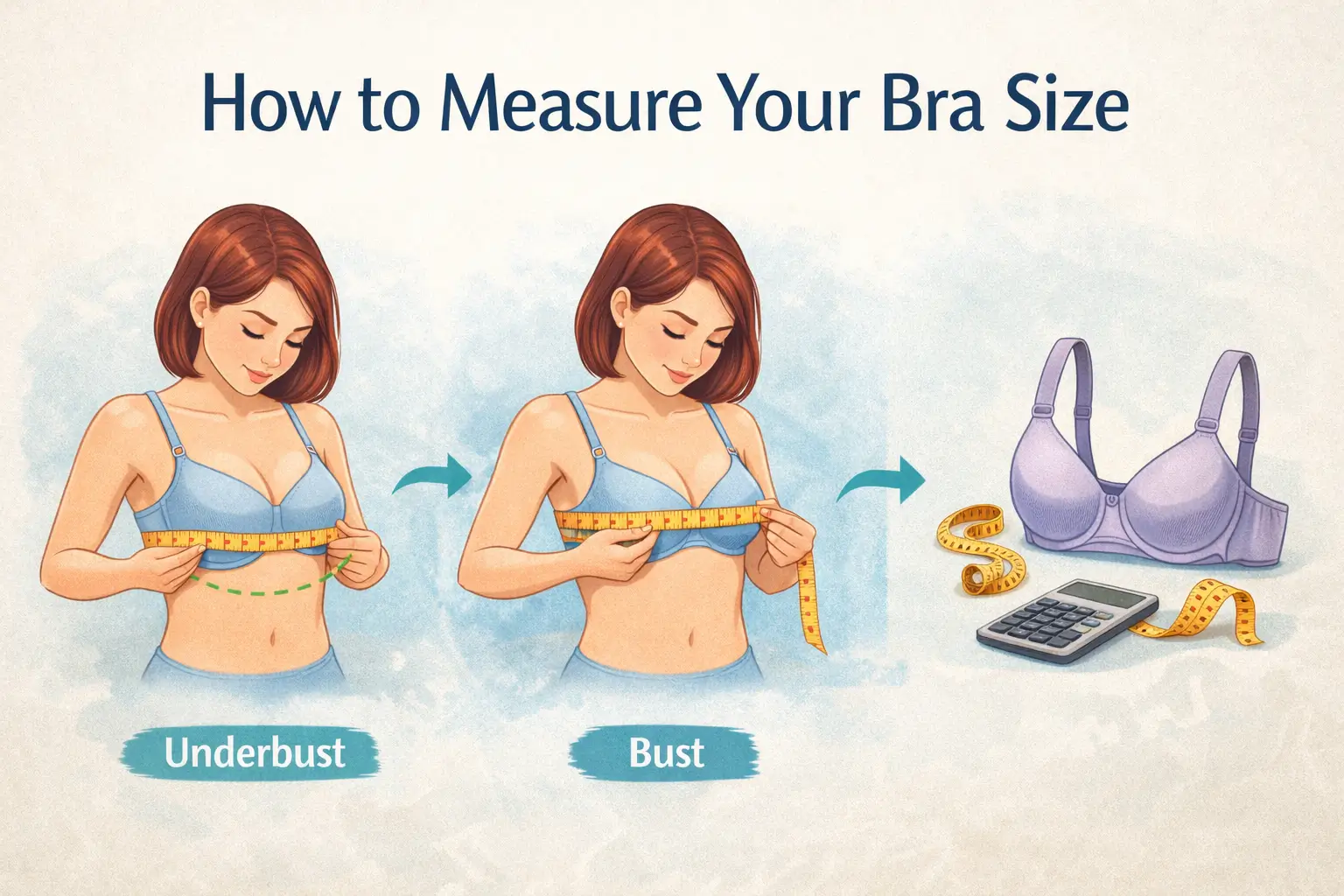
Wearing the wrong bra size can cause discomfort, poor posture, and even back pain. Yet studies suggest that the majority of women are wearing an ill-fitting bra. The good news? Learning how to measure your bra size at home is simple, and it only takes a few minutes.
This guide will walk you through everything you need to know to find your perfect fit — no guesswork required.
What You’ll Need
Before you start, gather these items:
- A soft measuring tape (the flexible kind used for sewing)
- A mirror (optional, but helpful)
- A well-fitting, non-padded bra (or measure braless for the most accurate results)
- A pen and paper to jot down your measurements
Don’t have a soft measuring tape? Use a piece of string or ribbon, then measure it against a ruler or hard measuring tape.
Understanding Bra Size Basics
A bra size consists of two parts:
- Band size (the number, e.g., 32, 34, 36) — This represents the measurement around your ribcage, just below your bust. The band provides most of the support.
- Cup size (the letter, e.g., A, B, C, D) — This represents the difference between your bust measurement and your band measurement. It indicates breast volume.
Together, they create your bra size (e.g., 34C, 36DD).
Here’s an important point many women don’t realize: cup size is relative to band size. A 32D has smaller cups than a 38D, even though both are “D cups.” This is why understanding both measurements matters.
Step 1: Measure Your Band Size
Your band size comes from measuring your ribcage directly under your bust.
How to do it:
- Stand straight with your arms relaxed at your sides
- Wrap the measuring tape around your torso, directly under your bust where your bra band would sit
- Make sure the tape is level all the way around (this is where a mirror helps)
- Pull the tape snug — firm enough that it stays in place, but not so tight that it digs into your skin
- Take a breath and measure on the exhale
- Note the measurement in inches
Converting to band size:
- If your measurement is an even number, that’s your band size
- If your measurement is an odd number, round up to the next even number
Example: If you measure 31 inches, your band size is 32. If you measure 34 inches, your band size is 34.
Step 2: Measure Your Bust Size
Your bust measurement is taken at the fullest part of your chest.
How to do it:
- Keep standing straight with arms relaxed
- Wrap the measuring tape around the fullest part of your bust (usually across the nipples)
- Keep the tape parallel to the floor — not angled up or down
- The tape should be snug but not compressing your breast tissue
- Note the measurement in inches
Tips for accuracy:
- Don’t pull the tape too tight; you want it to rest gently against your skin
- If you’re between numbers, round to the nearest whole number
- For the most consistent results, measure at the same time of day (breasts can fluctuate slightly due to hormones)
Step 3: Calculate Your Cup Size
Now comes the math — but don’t worry, it’s simple.
Subtract your band measurement from your bust measurement. The difference determines your cup size.
| Difference (inches) | Cup Size |
|---|---|
| 0 | AA |
| 1 | A |
| 2 | B |
| 3 | C |
| 4 | D |
| 5 | DD (E) |
| 6 | DDD (F) |
| 7 | G |
| 8 | H |
| 9 | I |
| 10 | J |
Example: If your band measurement is 34 inches and your bust measurement is 37 inches, the difference is 3 inches — making you a 34C.
Want to skip the calculations? Use our bra size calculator for instant results.
Bra Size Chart: Quick Reference
Here’s a handy chart showing common bra sizes based on underbust and bust measurements:
| Underbust (inches) | Band Size | Bust 1″ diff | Bust 2″ diff | Bust 3″ diff | Bust 4″ diff | Bust 5″ diff |
|---|---|---|---|---|---|---|
| 26-27 | 28 | 28A | 28B | 28C | 28D | 28DD |
| 28-29 | 30 | 30A | 30B | 30C | 30D | 30DD |
| 30-31 | 32 | 32A | 32B | 32C | 32D | 32DD |
| 32-33 | 34 | 34A | 34B | 34C | 34D | 34DD |
| 34-35 | 36 | 36A | 36B | 36C | 36D | 36DD |
| 36-37 | 38 | 38A | 38B | 38C | 38D | 38DD |
| 38-39 | 40 | 40A | 40B | 40C | 40D | 40DD |
| 40-41 | 42 | 42A | 42B | 42C | 42D | 42DD |
How to Check if Your Bra Fits Correctly
Measurements give you a starting point, but the true test is how the bra fits on your body. Here’s what to look for:
The Band
✓ Sits level and parallel to the floor (doesn’t ride up in back)
✓ Feels snug on the loosest hook (new bras stretch over time)
✓ You can fit two fingers underneath comfortably — no more, no less
The Cups
✓ Cups fully contain your breast tissue with no spillage or gaping
✓ The underwire (if present) sits flat against your ribcage
✓ The center gore (fabric between the cups) lies flat against your sternum
The Straps
✓ Stay in place without digging into your shoulders
✓ Carry minimal weight (the band should do most of the work)
✓ Allow one or two fingers to slide underneath easily
The Overall Fit
✓ You can move, breathe, and raise your arms comfortably
✓ No pinching, poking, or digging anywhere
✓ Your bust looks supported and naturally shaped under clothing
Understanding Sister Sizes
Sister sizes are bra sizes that share the same cup volume but have different band sizes. This is useful when your exact size isn’t available or when a particular style runs large or small.
How sister sizes work:
- Going up a band size? Go down a cup size
- Going down a band size? Go up a cup size
| Your Size | Sister Size (smaller band) | Sister Size (larger band) |
|---|---|---|
| 34B | 32C | 36A |
| 34C | 32D | 36B |
| 34D | 32DD | 36C |
| 36C | 34D | 38B |
| 36D | 34DD | 38C |
Example: If you’re a 34C but a bra only comes in 32 or 36, try 32D (smaller band, larger cup) or 36B (larger band, smaller cup).
Sister sizes maintain the same cup volume, so the fit should be similar — though the band will feel tighter or looser accordingly.
International Bra Size Conversion
Bra sizing varies by country. If you’re shopping from international brands, use this conversion chart:
| US | UK | EU | Australia | Japan |
|---|---|---|---|---|
| 32A | 32A | 70A | 10A | 70A |
| 32B | 32B | 70B | 10B | 70B |
| 32C | 32C | 70C | 10C | 70C |
| 34B | 34B | 75B | 12B | 75B |
| 34C | 34C | 75C | 12C | 75C |
| 34D | 34D | 75D | 12D | 75D |
| 36C | 36C | 80C | 14C | 80C |
| 36D | 36D | 80D | 14D | 80D |
| 36DD | 36DD | 80E | 14DD | 80E |
| 38D | 38D | 85D | 16D | 85D |
| 38DD | 38DD | 85E | 16DD | 85E |
Note that UK and US sizes are similar for smaller cups but diverge at DD and above. Always check the brand’s specific size chart when shopping internationally.
When to Re-Measure Your Bra Size
Your bra size isn’t static — it can change throughout your life. Consider re-measuring if you experience:
- Weight changes of 10 pounds or more
- Pregnancy or breastfeeding (your size may change multiple times)
- Hormonal shifts such as menopause or starting/stopping birth control
- Aging (breast tissue composition changes over time)
- Changes in fitness level (muscle gain or loss in the chest and back)
According to Healthline, breast size can fluctuate due to hormonal changes, weight fluctuations, and aging — making regular measurement important for ongoing comfort.
As a general rule, measure yourself at least once a year or whenever your current bras start feeling uncomfortable.
Common Measuring Mistakes to Avoid
Even with the right technique, small errors can throw off your results:
- Measuring over a padded bra — Padding adds volume that skews your bust measurement. Use a non-padded bra or go braless.
- Pulling the tape too tight — This compresses tissue and gives you a smaller measurement than reality. The tape should be snug but comfortable.
- Letting the tape sag or angle — An uneven tape leads to inaccurate numbers. Always keep it level and parallel to the floor.
- Holding your breath — Measure on a normal exhale for the most accurate band size.
- Only measuring once — Take each measurement two or three times and use the average for best accuracy.
Tips for Different Breast Shapes
Breast shape affects how different bra styles fit, even in the correct size. Here’s a quick guide:
- Full on top: Look for full-coverage bras or balconettes that accommodate upper fullness without cutting in.
- Full on bottom: Plunge styles and push-up bras work well, as they lift from below.
- Wide-set: Choose plunge bras with a low, narrow gore that won’t press against breast tissue.
- Close-set: Side-support bras or styles with a wider gore help create separation.
- Asymmetrical: Fit to the larger breast and use a removable pad to balance the smaller side if needed.
Understanding your shape helps you choose styles that complement your measurements — because size is only part of the equation.
Finding Your Perfect Fit
Measuring your bra size at home is the first step toward better comfort and support. Remember:
- Measure your underbust for band size
- Measure your bust at the fullest point
- Subtract to find your cup size
- Always try bras on and assess the fit
- Re-measure periodically as your body changes
Your calculated size is a starting point — not a hard rule. Sizing varies between brands, and fit matters more than the number on the tag. Trust how the bra feels on your body.
Ready to find your size? Try our free bra size calculator for personalized results in seconds.
Frequently Asked Questions
How often should I measure my bra size?
At least once a year, or whenever you notice changes in how your bras fit.
Can I measure myself, or do I need someone to help?
You can absolutely measure yourself. A mirror helps you ensure the tape is level.
What if I’m between sizes?
Try both sizes and see which feels better. You can also explore sister sizes for more options
Why does my size vary between brands?
There’s no universal sizing standard in the lingerie industry. Always consult each brand’s specific size chart.
Should I measure with or without a bra?
For the most accurate results, measure without a bra or in a thin, non-padded bra.

Comments