
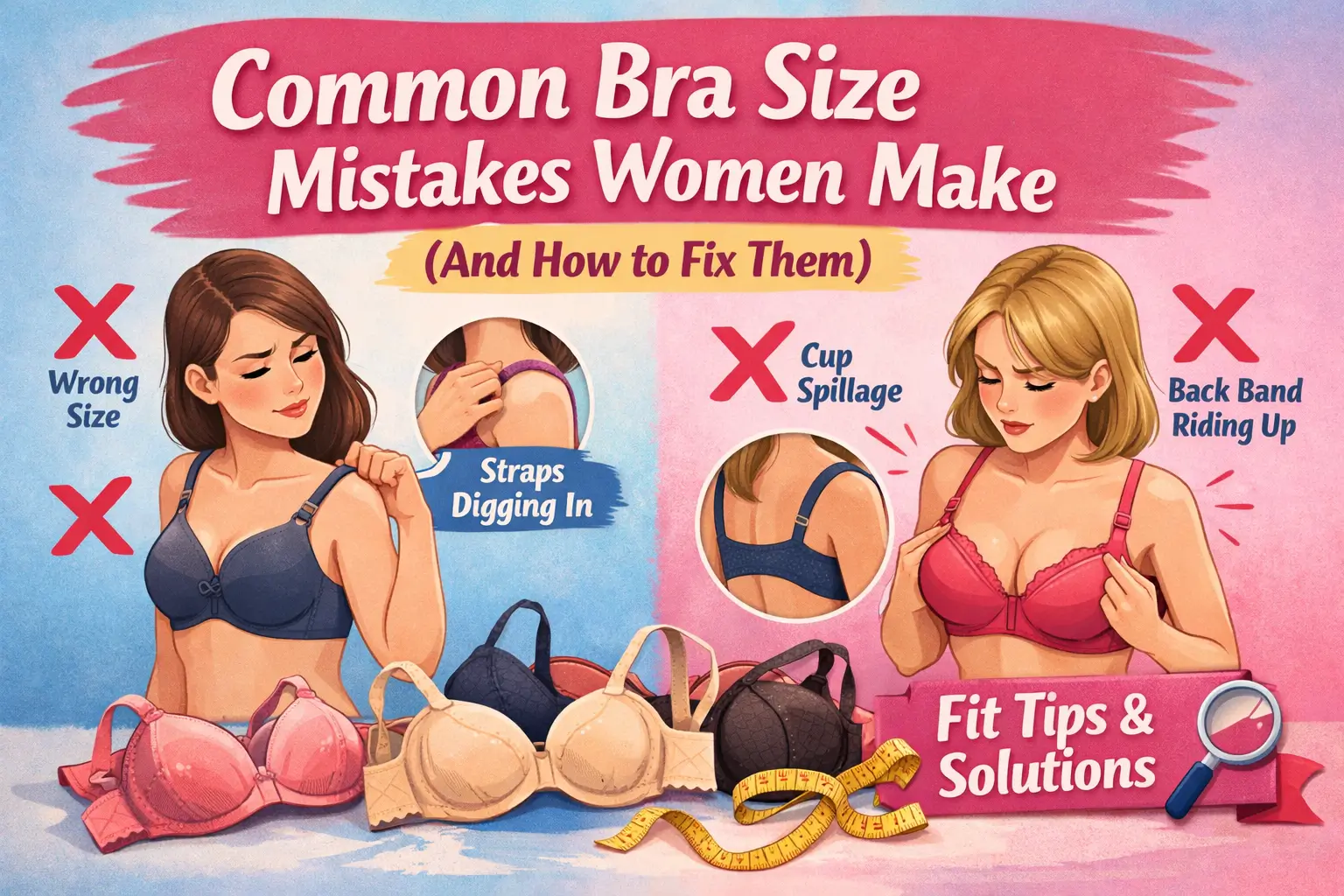
Finding the perfect bra fit can feel like searching for a needle in a haystack. Studies suggest that up to 80% of women wear the wrong bra size—and most don’t even realize it. If you’ve ever dealt with straps that slip, bands that ride up, or cups that gap or overflow, you’re not alone.
In this guide, we’ll walk through the most common bra sizing mistakes women make and show you exactly how to achieve a comfortable, supportive fit.
Why Bra Fit Matters More Than You Think
Wearing the wrong bra size isn’t just uncomfortable—it can affect your posture, cause back and shoulder pain, and even impact how your clothes fit. A properly fitted bra provides support, enhances your silhouette, and boosts your confidence throughout the day.
The Most Common Bra Size Mistakes
1. Wearing the Same Size You’ve Always Worn
Your bra size isn’t static. Weight fluctuations, hormonal changes, pregnancy, breastfeeding, and aging all affect your breast size and shape. Many women continue wearing the same size they were fitted for years—or even decades—ago.
The fix: Get professionally measured at least once a year, or whenever you notice changes in how your bras fit.
2. Focusing Only on Cup Size
One of the biggest misconceptions is that cup size is universal. In reality, a 34D and a 38D have completely different cup volumes. Cup size is relative to band size, which means a D cup on a smaller band holds less volume than a D cup on a larger band.
The fix: Understand the relationship between band and cup size. If you’re between sizes, try sister sizes (for example, 34C = 32D = 36B).
3. Choosing the Wrong Band Size
The band provides approximately 80% of a bra’s support, yet many women wear bands that are too loose. If your band rides up in the back, it’s likely too big.
Signs your band is too loose:
- The band rides up your back
- You can fit more than two fingers under it
- The straps carry most of the weight
Signs your band is too tight:
- It digs into your skin
- It’s difficult to breathe comfortably
- Red marks remain after removal
The fix: Your band should sit parallel to the floor and feel snug on the loosest hook when new. This allows room to tighten as the elastic stretches over time.
4. Ignoring the Gore (Center Panel)
The gore is the fabric or underwire piece between the cups. On a well-fitting bra, it should lie flat against your sternum. If it floats away from your body, your cups are likely too small.
The fix: When trying on bras, always check that the gore sits flush against your chest.
5. Relying Too Heavily on Adjustable Straps
Straps are meant for minor adjustments, not primary support. If you’re constantly tightening your straps to lift and support, your band size is probably too large.
The fix: Focus on getting the right band size first. Straps should stay in place without digging into your shoulders.
6. Not Scooping and Swooping
Most women simply pull on their bra without properly positioning their breast tissue. The “scoop and swoop” method ensures all tissue is contained within the cup for accurate fit assessment.
How to scoop and swoop:
- Lean forward and let your breasts fall into the cups
- Use your hand to gently scoop tissue from under your arms into the cup
- Adjust the underwire to sit in your inframammary fold (where your breast meets your chest wall)
7. Assuming All Bras Fit the Same
Just like clothing, bra sizing varies between brands and even styles within the same brand. A 34C in one brand might fit completely differently in another. Different cuts—plunge, balconette, full coverage—also fit various breast shapes differently.
The fix: Always try before you buy, and be open to different sizes in different styles.
8. Wearing the Wrong Bra Style for Your Breast Shape
Breast shape affects which styles work best for you. Full-on-top breasts need different support than full-on-bottom breasts. Wide-set breasts require different cup placement than close-set breasts.
Common breast shapes and ideal styles:
- Full on top: Full-coverage or balconette bras
- Full on bottom: Push-up or plunge styles
- Wide-set: Plunge bras with a lower gore
- Close-set: Side-support or push-up styles
9. Keeping Bras Past Their Lifespan
Bras lose elasticity and support over time. Wearing the same few bras every week accelerates wear. Most bras should be replaced every 6–12 months with regular wear.
Signs it’s time for a new bra:
- The band has stretched out (you’re on the tightest hook)
- The underwire is poking through
- The cups are warped or misshapen
- The straps won’t stay up even when adjusted
10. Not Considering Lifestyle Needs
Wearing the wrong type of bra for your activities can compromise both comfort and support. A lace bralette won’t provide adequate support during a workout, and a heavily padded bra might be uncomfortable for all-day desk work.
The fix: Build a bra wardrobe with options for different occasions—everyday t-shirt bras, sports bras for exercise, comfortable wireless options for lounging, and special occasion pieces.
How to Find Your Correct Bra Size
Want to skip the math? Use our free bra size calculator for instant, accurate results. Or follow these steps to measure manually:
Step 1: Measure Your Band Size
Using a soft measuring tape, measure snugly around your ribcage, directly under your bust. Round to the nearest whole number. If the number is even, that’s your band size. If odd, round up to the next even number.
Step 2: Measure Your Bust
Measure around the fullest part of your bust, keeping the tape parallel to the floor. Don’t pull too tight.
Step 3: Calculate Your Cup Size
Subtract your band measurement from your bust measurement. Each inch of difference equals one cup size:
- 1 inch = A
- 2 inches = B
- 3 inches = C
- 4 inches = D
- 5 inches = DD/E
Step 4: Try It On
Numbers are just a starting point. The true test is how the bra fits on your body.
The Bottom Line
Finding your perfect bra size is a journey, not a destination. Your body changes, styles vary, and what works today might not work tomorrow. The key is understanding what proper fit looks and feels like, staying open to trying new sizes and styles, and prioritizing comfort and support over the number on the tag.
Remember: the “right” size is the one that fits your unique body—not the one you think you should be wearing.

Comments